
Strategi Transformasi Digital Sistem Informasi Geografis Nasional dalam Mendukung Keamanan Maritim Indonesia Menuju Indonesia Emas 2045
Article Sidebar
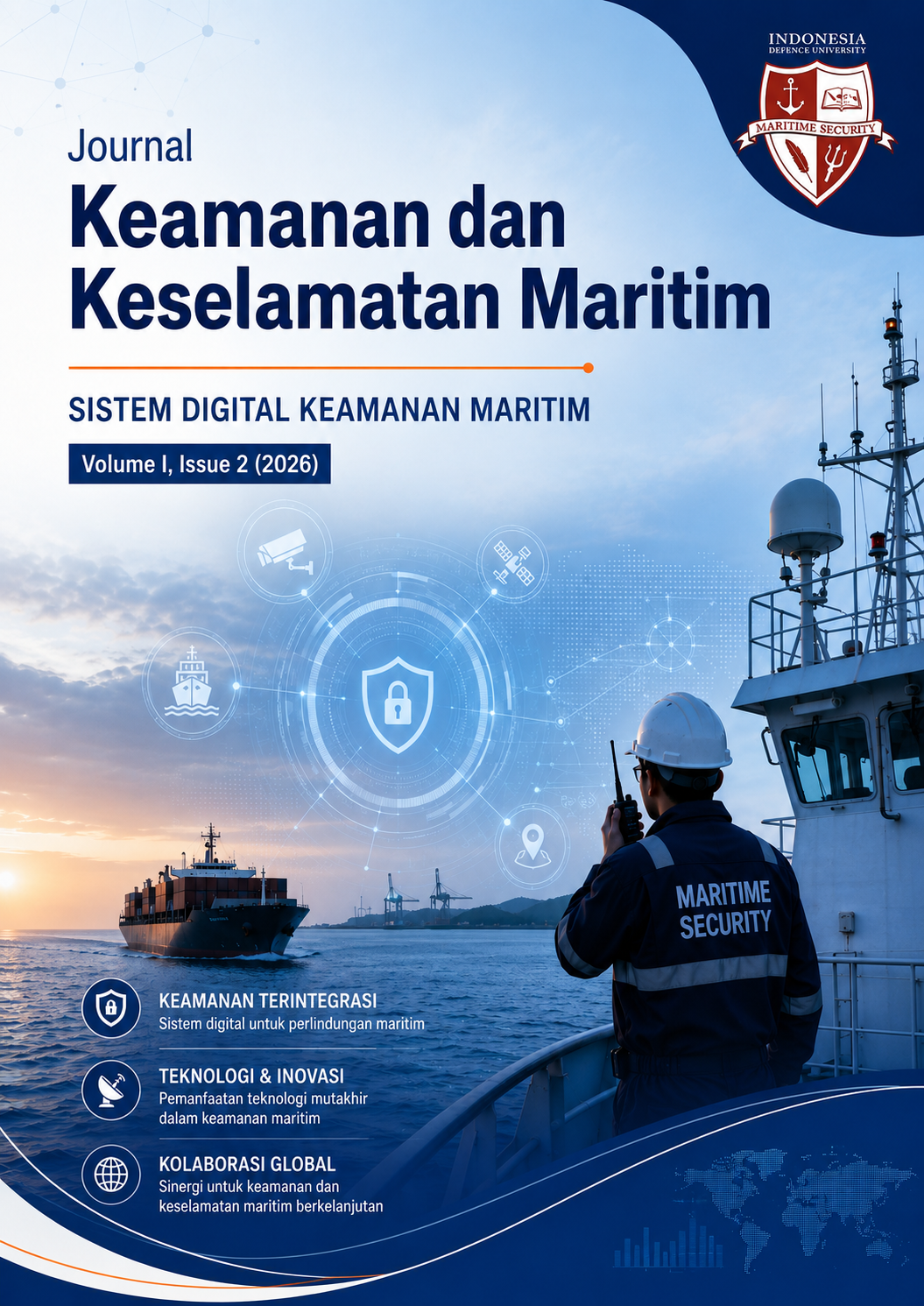
Main Article Content
Abstract
Keamanan maritim Indonesia menghadapi kesenjangan struktural antara luas yurisdiksi laut yang harus diawasi dan kapasitas Sistem Informasi Geografis (SIG) Nasional yang masih terfragmentasi antarlembaga, belum sepenuhnya terintegrasi dengan teknologi digital mutakhir, dan rentan terhadap ancaman siber yang terus berkembang. Literatur yang membahas transformasi digital, geoinformatika, dan keamanan maritim selama ini berkembang secara terpisah menurut disiplin masing-masing, sehingga belum tersedia kerangka strategi yang menautkan seluruh dimensi tersebut secara terintegrasi bagi konteks kepulauan Indonesia menuju Indonesia Emas 2045. Penelitian ini mengembangkan strategi transformasi digital SIG Nasional sebagai fondasi keamanan maritim melalui integrasi kecerdasan buatan, big data, Internet of Things, cloud computing, digital twin, penginderaan jauh, Spatial Data Infrastructure, dan Marine Spatial Data Infrastructure. Penelitian menggunakan Systematic Literature Review mengikuti protokol PRISMA 2020, dipadukan dengan narrative synthesis, thematic analysis, dan critical literature synthesis. Pencarian pada basis data Scopus dan Web of Science menghasilkan 70 rekaman awal, yang setelah penghapusan duplikasi, penyaringan judul-abstrak, dan penilaian kualitas menggunakan kriteria CASP dan AACODS, menyisakan 47 artikel sebagai korpus akhir. Hasil sintesis menunjukkan bahwa transformasi digital SIG Nasional menghadapi empat lapis tantangan yang saling mengunci, yaitu fragmentasi data, kerentanan siber, kesenjangan kompetensi sumber daya manusia, dan ketiadaan kebijakan yang mengikat lintas instansi. Penelitian ini merumuskan kerangka kompetensi SDM tiga jenjang, empat elemen kebijakan nasional, empat pilar keamanan siber data geospasial, rantai nilai integrasi teknologi enam lapisan, lima prinsip strategi nasional, serta roadmap implementasi empat fase sepanjang 2025–2045. Temuan ini menegaskan bahwa keberhasilan transformasi digital ditentukan oleh urutan pembangunan kapasitas pada keempat lapis tersebut, bukan oleh kecanggihan teknologi semata. Penelitian ini berkontribusi memperluas kerangka transformasi digital ke ranah geospasial-maritim, menawarkan pendekatan sintesis kritis lintas disiplin, dan menyediakan peta jalan operasional bagi Badan Informasi Geospasial, Kementerian Pertahanan, dan Badan Keamanan Laut dalam merancang arsitektur SIG Nasional yang tangguh menuju Indonesia Emas 2045.
Article Details
Section
How to Cite
References
Agarwal, N., Sahay, A., Shah, S. M., Babu, K. N., Thapliyal, P. K., Dube, N., Sharma, R., & Desai, N. M. (2025). Remote sensing, geospatial and AI/ML techniques: Catalysing growth in India’s blue economy. CSI Transactions on ICT, 13(1), 27–42. https://doi.org/10.1007/s40012-025-00408-w
Al Subhi, N. H., & Al Suqri, M. N. (2025). Integrating AI and Blockchain in Marine Spatial Data Infrastructure: Enhancing Cybersecurity and Business Intelligence for Maritime Innovation. 2025 International Conference on Business Intelligence for Technology Innovation (ICBITI), 1–6. https://doi.org/10.1109/ICBITI65527.2025.11500914
Alanhdi, A., & Toka, L. (2024). A Survey on Integrating Edge Computing With AI and Blockchain in Maritime Domain, Aerial Systems, IoT, and Industry 4.0. IEEE Access, 12, 28684–28709. https://doi.org/10.1109/ACCESS.2024.3367118
Al-Subhiyah, N. H. (2025). ADVANCING MARITIME SECURITY AND MARINE BIODIVERSITY PROTECTION UNDER OMAN VISION 2040: THE STRATEGIC ROLE OF MARINE SPATIAL DATA INFRASTRUCTURE (MSDI). Journal of Strategic and Defense Studies (JSDS), 1(1), e453. https://doi.org/10.66209/jsds.2025.453
Arvidsson, B., Johansson, J., & Guldåker, N. (2021). Critical infrastructure, geographical information science and risk governance: A systematic cross-field review. Reliability Engineering & System Safety, 213, 107741. https://doi.org/10.1016/j.ress.2021.107741
Ashraf, I., Park, Y., Hur, S., Kim, S. W., Alroobaea, R., Zikria, Y. B., & Nosheen, S. (2023). A Survey on Cyber Security Threats in IoT-Enabled Maritime Industry. IEEE Transactions on Intelligent Transportation Systems, 24(2), 2677–2690. https://doi.org/10.1109/TITS.2022.3164678
Bashir, M. O. I., & Zakaria, N. M. G. (2025). Systematic Review of Digital Transformation in Maritime Governance in Developing Nations: The Case of Bangladesh. BUP Journal, 12(1), 15–46. https://doi.org/10.63888/bj/chsr/25a/sdtmg
Braun, V., & Clarke, V. (2006). Using thematic analysis in psychology. Qualitative Research in Psychology, 3(2), 77–101. https://doi.org/10.1191/1478088706qp063oa
Dangermond, J., & Goodchild, M. F. (2020). Building geospatial infrastructure. Geo-Spatial Information Science, 23(1), 1–9. https://doi.org/10.1080/10095020.2019.1698274
Deanto, M. A. R., & Marzaman, A. P. (2024). Transformasi Kebijakan Maritim dalam Era Digital: Peran Teknologi dalam Meningkatkan Efektivitas dan Keamanan Lautan di Indonesia. Journal of International and Local Studies, 8(1), 1–9. https://doi.org/10.56326/jils.v8i1.3678
Denyer, D., & Tranfield, D. (2009). Producing a Systematic Review. The SAGE Handbook of Organizational Research Methods, 671–689.
Diaz, R., Smith, K., Bertagna, S., & Bucci, V. (2023). Digital Transformation, Applications, and Vulnerabilities in Maritime and Shipbuilding Ecosystems. Procedia Computer Science, 217, 1396–1405. https://doi.org/10.1016/j.procs.2022.12.338
Flynn, S., Tray, E., Woolley, T., Leadbetter, A., Heney, K., O’Driscoll, D., Nic Aonghusa, C., & Conway, A. (2023). Management of spatial data integrity including stakeholder feedback in Maritime Spatial Planning. Marine Policy, 156, 105799. https://doi.org/10.1016/j.marpol.2023.105799
Golgota, A., & Çerma, U. (2024). Securing Durres Port’s Digital Transformation: Cybersecurity Strategy for Maritime Industry. 2024 13th Mediterranean Conference on Embedded Computing (MECO), 1–4. https://doi.org/10.1109/MECO62516.2024.10577771
Grant, M. J., & Booth, A. (2009). A typology of reviews: An analysis of 14 review types and associated methodologies. Health Information & Libraries Journal, 26(2), 91–108. https://doi.org/10.1111/j.1471-1842.2009.00848.x
Graziano, M. D., D’Errico, M., & Razzano, E. (2012). Constellation analysis of an integrated AIS/remote sensing spaceborne system for ship detection. Advances in Space Research, 50(3), 351–362. https://doi.org/10.1016/j.asr.2012.04.020
Hanelt, A., Bohnsack, R., Marz, D., & Antunes Marante, C. (2021). A Systematic Review of the Literature on Digital Transformation: Insights and Implications for Strategy and Organizational Change. Journal of Management Studies, 58(5), 1159–1197. https://doi.org/10.1111/joms.12639
Higgins, J. P. T., Thomas, J., Chandler, J., Cumpston, M., Li, T., Page, M. J., & Welch, V. A. (Eds.). (2019). Cochrane Handbook for Systematic Reviews of Interventions (1st ed.). Wiley. https://doi.org/10.1002/9781119536604
Hopcraft, R. (2021). Developing Maritime Digital Competencies. IEEE Communications Standards Magazine, 5(3), 12–18. https://doi.org/10.1109/MCOMSTD.101.2000073
Huang, X., Song, Y., & Hu, X. (2021). Deploying Spatial Data for Coastal Community Resilience: A Review from the Managerial Perspective. International Journal of Environmental Research and Public Health, 18(2), 830. https://doi.org/10.3390/ijerph18020830
Isbaex, C., Costa, F. D. R. F., & Batista, T. (2025). Application of GIS in the Maritime-Port Sector: A Systematic Review. Sustainability, 17(8), 3386. https://doi.org/10.3390/su17083386
Jardim, R., Dos Santos, M., Neto, E., Muradas, F. M., Santiago, B., & Moreira, M. (2022). Design of a framework of military defense system for governance of geoinformation. Procedia Computer Science, 199, 174–181. https://doi.org/10.1016/j.procs.2022.01.022
Jones, A., Koehler, S., Jerge, M., Graves, M., King, B., Dalrymple, R., Freese, C., & Von Albade, J. (2023). BATMAN: A Brain-like Approach for Tracking Maritime Activity and Nuance. Sensors, 23(5), 2424. https://doi.org/10.3390/s23052424
Kallimani, J. G. (2018). The Challenges of Digitisation and Data Analysis in the Maritime Domain. Maritime Affairs: Journal of the National Maritime Foundation of India, 14(1), 36–50. https://doi.org/10.1080/09733159.2018.1478433
Karhunen, P., Kankaanranta, A., Louhiala‐Salminen, L., & Piekkari, R. (2018). Let’s Talk about Language: A Review of Language‐Sensitive Research in International Management. Journal of Management Studies, 55(6), 980–1013. https://doi.org/10.1111/joms.12354
Kechagias, E. P., Chatzistelios, G., Papadopoulos, G. A., & Apostolou, P. (2022). Digital transformation of the maritime industry: A cybersecurity systemic approach. International Journal of Critical Infrastructure Protection, 37, 100526. https://doi.org/10.1016/j.ijcip.2022.100526
Kijewski-Correa, T., Taflanidis, A., Vardeman, C., Sweet, J., Zhang, J., Snaiki, R., Wu, T., Silver, Z., & Kennedy, A. (2020). Geospatial Environments for Hurricane Risk Assessment: Applications to Situational Awareness and Resilience Planning in New Jersey. Frontiers in Built Environment, 6, 549106. https://doi.org/10.3389/fbuil.2020.549106
Kitchenham, B. (2007). Guidelines for performing systematic literature reviews in software engineering. Technical Report, Ver. 2.3 EBSE Technical Report. EBSE, undefined-undefined.
Koca, Y. N., & Erdoğan, S. (2024). Are We Ready for Digitalisation? A Study of the Challenges and Barriers to Digitalisation and Technology Use in the Turkish Maritime Sector. Polish Maritime Research, 31(2), 132–139. https://doi.org/10.2478/pomr-2024-0029
Kusmantoro, Y., Trismadi, T., & Harsono, G. (2024). Pemanfaatan Teknologi Geospatial Intelligence (GEOINT) untuk Peningkatan Keamanan dan Pengelolaan Maritim di Indonesia. Journal on Education, 7(1), 8218–8235. https://doi.org/10.31004/joe.v7i1.7653
Li, M., Zhou, J., Chattopadhyay, S., & Goh, M. (2024). Maritime Cybersecurity: A Comprehensive Review (arXiv:2409.11417). arXiv. https://doi.org/10.48550/arXiv.2409.11417
Lim, H., Jeong, M., Lee, J., Jeon, S., & Lee, C. (2026). Arctic Green Maritime Data Governance for Green Shipping Corridors: Interpreting the EU Data Act. Sustainability, 18(2), 577. https://doi.org/10.3390/su18020577
Liu, J., Li, C., Bai, J., Luo, Y., Lv, H., & Lv, Z. (2021). Security in IoT-Enabled Digital Twins of Maritime Transportation Systems. IEEE Transactions on Intelligent Transportation Systems, 1–9. https://doi.org/10.1109/TITS.2021.3122566
Margaretha, R., Syuzairi, M., & Mahadiansar, M. (2024). Digital Transformation in the Maritime Industry; Opportunities and Challenges for Indonesia. Journal of Maritime Policy Science, 1(1), 1–10. https://doi.org/10.31629/jmps.v1i1.7003
Mayring, P. (2014). Qualitative content analysis: Theoretical foundation, basic procedures and software solution (free download via Social Science Open Access Repository SSOAR). Forum Qualitative Sozialforschung/Forum: Qualitative Social Research, (10), 1–143.
Mongeon, P., & Paul-Hus, A. (2016). The journal coverage of Web of Science and Scopus: A comparative analysis. Scientometrics, 106(1), 213–228. https://doi.org/10.1007/s11192-015-1765-5
Nadkarni, S., & Prügl, R. (2021). Digital transformation: A review, synthesis and opportunities for future research. Management Review Quarterly, 71(2), 233–341. https://doi.org/10.1007/s11301-020-00185-7
Nguyen, T.-N.-L., & Le, S.-T. (2025). Factors Leading to the Digital Transformation Dead Zone in Shipping SMEs: A Dynamic Capability Theory Perspective. Sustainability, 17(12), 5553. https://doi.org/10.3390/su17125553
Page, M. J., McKenzie, J. E., Bossuyt, P. M., Boutron, I., Hoffmann, T. C., Mulrow, C. D., Shamseer, L., Tetzlaff, J. M., Akl, E. A., Brennan, S. E., Chou, R., Glanville, J., Grimshaw, J. M., Hróbjartsson, A., Lalu, M. M., Li, T., Loder, E. W., Mayo-Wilson, E., McDonald, S., … Moher, D. (2021). The PRISMA 2020 statement: An updated guideline for reporting systematic reviews. BMJ, n71. https://doi.org/10.1136/bmj.n71
Pekkanen, S. M., Aoki, S., & Mittleman, J. (2022). Small Satellites, Big Data: Uncovering the Invisible in Maritime Security. International Security, 47(2), 177–216. https://doi.org/10.1162/isec_a_00445
Petticrew, M., & Roberts, H. (2006). Systematic Reviews in the Social Sciences: A Practical Guide (1st ed.). Wiley. https://doi.org/10.1002/9780470754887
Popay, J., Baldwin, S., Arai, L., Britten, N., Petticrew, M., Rodgers, M., & Sowden, A. (2007). Guidance on the Conduct of Narrative Synthesis in Systematic Reviews. ESRC Methods Programme, (January), undefined-undefined.
Ramesh, K., & Bhaskaran, B. (2025). Integrating Geographic Information Systems in Maritime Port Development for Enhanced Resource Planning. Indian Journal of Information Sources and Services, 15(4), 320–324. https://doi.org/10.51983/ijiss-2025.IJISS.15.4.36
Rawson, A., Sabeur, Z., & Brito, M. (2022). Intelligent geospatial maritime risk analytics using the Discrete Global Grid System. Big Earth Data, 6(3), 294–322. https://doi.org/10.1080/20964471.2021.1965370
Ray, C., Dréo, R., Camossi, E., Jousselme, A.-L., & Iphar, C. (2019). Heterogeneous integrated dataset for Maritime Intelligence, surveillance, and reconnaissance. Data in Brief, 25, 104141. https://doi.org/10.1016/j.dib.2019.104141
Reggiannini, M., Salerno, E., Bacciu, C., D’Errico, A., Lo Duca, A., Marchetti, A., Martinelli, M., Mercurio, C., Mistretta, A., Righi, M., Tampucci, M., & Paola, C. D. (2024). Remote Sensing for Maritime Traffic Understanding. Remote Sensing, 16(3), 557. https://doi.org/10.3390/rs16030557
Rumson, A. G., Hallett, S. H., & Brewer, T. R. (2017). Coastal risk adaptation: The potential role of accessible geospatial Big Data. Marine Policy, 83, 100–110. https://doi.org/10.1016/j.marpol.2017.05.032
Sanchez-Gonzalez, P.-L., Díaz-Gutiérrez, D., Leo, T. J., & Núñez-Rivas, L. R. (2019). Toward Digitalization of Maritime Transport? Sensors, 19(4), 926. https://doi.org/10.3390/s19040926
Schwartz-Belkin, I., & Portman, M. E. (2024). Exploring barriers to the implementation of geospatial technologies in marine spatial planning: Reports from practitioners. Marine Policy, 159, 105891. https://doi.org/10.1016/j.marpol.2023.105891
Şengül, B., Yılmaz, F., & Uğurlu, Ö. (2023). Safety–Security Analysis of Maritime Surveillance Systems in Critical Marine Areas. Sustainability, 15(23), 16381. https://doi.org/10.3390/su152316381
Singh, J. (2013). Critical appraisal skills programme. Journal of Pharmacology and Pharmacotherapeutics, 4(1), 76–77. https://doi.org/10.4103/0976-500X.107697
Subhi, N. H. A., & Suqri, M. N. A. (2025). Integrating Technology, Sustainability, and the Blue Economy to Strengthen Maritime Security and Climate Resilience under Oman’s Vision 2040. Hong Kong Journal of Social Sciences, (0), 11. https://doi.org/https://doi.org/10.55463/hkjss.issn.1021-3619.66.9
Surucu-Balci, E., Iris, Ç., & Balci, G. (2024). Digital information in maritime supply chains with blockchain and cloud platforms: Supply chain capabilities, barriers, and research opportunities. Technological Forecasting and Social Change, 198, 122978. https://doi.org/10.1016/j.techfore.2023.122978
Syms, M. S., Isenor, A. W., Chivari, B., DeBaie, A., Hogue, A., & Glessing, B. (2021). Building a Maritime Picture in the Era of Big Data: The Development of the Geospatial Communication Interface+. 2021 International Conference on Military Communication and Information Systems (ICMCIS), 1–7. https://doi.org/10.1109/ICMCIS52405.2021.9486392
Tavra, M., Jajac, N., & Cetl, V. (2017). Marine Spatial Data Infrastructure Development Framework: Croatia Case Study. ISPRS International Journal of Geo-Information, 6(4), 117. https://doi.org/10.3390/ijgi6040117
Tijan, E., Jović, M., Aksentijević, S., & Pucihar, A. (2021). Digital transformation in the maritime transport sector. Technological Forecasting and Social Change, 170, 120879. https://doi.org/10.1016/j.techfore.2021.120879
Tranfield, D., Denyer, D., & Smart, P. (2003). Towards a Methodology for Developing Evidence‐Informed Management Knowledge by Means of Systematic Review. British Journal of Management, 14(3), 207–222. https://doi.org/10.1111/1467-8551.00375
Tyndall, J. (2010). AACODS Checklist. Chinese Journal of Evidence-Based Medicine, 7(1), 507–513.
Wang, W. (2024). Innovative strategies and forward thinking on China’s digital maritime law enforcement. Marine Policy, 169, 106369. https://doi.org/10.1016/j.marpol.2024.106369
Zhou, X., Huang, Z., Xia, T., Zhang, X., Duan, Z., Wu, J., & Zhou, G. (2025). The integrated application of big data and geospatial analysis in maritime transportation safety management: A comprehensive review. International Journal of Applied Earth Observation and Geoinformation, 138, 104444. https://doi.org/10.1016/j.jag.2025.104444
Zissis, D., Chatzikokolakis, K., Spiliopoulos, G., & Vodas, M. (2020). A Distributed Spatial Method for Modeling Maritime Routes. IEEE Access, 8, 47556–47568. https://doi.org/10.1109/ACCESS.2020.2979612